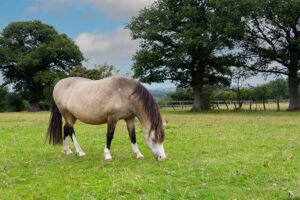
Cushing’s disease is a hormonal disease of horses often caused by a pituitary gland tumor. Cushing’s is one of the most commonly diagnosed endocrine disorders of horses, affecting approximately 0.1% to 0.5% of all horses. Ponies appear to be more frequently affected than horses, but there does not appear to be a breed or sex predilection. Equine Cushing’s disease can have a long, slow onset, which makes diagnosis difficult. In addition, none of the available tests for the disease are perfect. There is no cure for Cushing’s disease. Despite being incurable, horses with Cushing’s disease can live comfortably if they are managed appropriately.
This fact sheet includes an overview of the disease, clinical signs, diagnosis, treatment and prognosis for future health.