Stringhalt in Horses
- Topics: Article
For centuries this neurologic disease has left veterinarians and scientists scratching their heads.
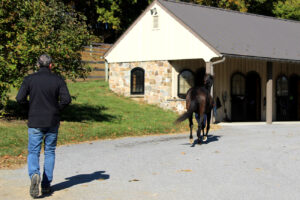
A jerk, a jump, a hop with the hind legs tucked up high. Similar to the function of strings on a marionette, stringhalt seems to make horses yank their legs up and halt them there momentarily before taking their next step. This uncontrollable exaggerated movement of the digital extensor muscles is the outward sign of neurologic disease, sometimes caused by toxicity, sometimes of unknown origin. If time doesn't cure it, the prognosis is poor. But today researchers are hard at work looking into ways to make horses with this condition safe, happy, and free of clinical signs.
History, Clinical Signs, and Causes
Stringhalt appears to be an age-old disease in horses and other hooved animals. Descriptions of the disease date back to the Renaissance. William Shakespeare has even been credited for the name of the disease (as a variation of the term "springhalt," from Henry VIII).
Stringhalt occurs when the digital extensor muscles contract excessively or when the digital flexor muscles lack sufficient opposition, according to Caroline Hahn, DVM, PhD, MRCVS, Dipl. ECEIM, ECVN, senior lecturer and researcher in the neuromuscular disease laboratory of the University of Edinburgh's Royal (Dick) School of Veterinary Studies, in Scotland
Create a free account with TheHorse.com to view this content.
TheHorse.com is home to thousands of free articles about horse health care. In order to access some of our exclusive free content, you must be signed into TheHorse.com.
Start your free account today!
Already have an account?
and continue reading.

Related Articles

Stay on top of the most recent Horse Health news with