Farm Call: Your Questions Answered
Pelvic Fracture
December 01, 2005
Q.
Q: My 6-year-old mare suffered a pelvic fracture from a pasture accident five months ago. My veterinarian examined her and prescribed stall rest. What timeframe can I expect for starting light exercise and how can I tell if she is ready? Should I expect to ride her again? Dawn
A: Most pelvic fractures have a good prognosis
Shoeing Wild Horses
December 01, 2005
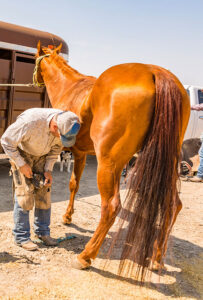
Q. I've just adopted a wild horse and have heard that they often don't need shoes. She is in a quarter-acre dry lot connected to a 10-acre irrigated pasture for turn-out. Do we need to shoe her?
Urinating Too Often?
November 01, 2005
Q.
My 3-year-old registered Paint gelding urinates up to three times in a three-to-four hour period. My veterinarian has checked a blood profile and two urinalyses. The blood profile was normal and the first urinalysis showed elevated protein. The second urine sample was normal. If we are still concerned about a kidney problem, what other tests can we do? Is there something else we should look
Snake Bite Preparedness
October 01, 2005
Q.
Q: Our area has a healthy population of rattlesnakes. We spend six to 10 hours a week on trails where we have seen snakes. I would like to be prepared in the event one of our horses gets bitten. What are the procedures and supplies we should have on hand? Pat
A: When on
Pinworm Problems
October 01, 2005
Q. I have a 10-year-old mare being treated for pinworms. She incessantly rubs her tail. She also uses the wall of her stall or anything else available to lean on while defecating. Are these signs related? Could they be behavioral?
Swollen Thyroid Gland
September 01, 2005
Q.
My 19-year-old Quarter Horse gelding has a swollen thyroid gland on the right side of his throatlatch. It was about the size of a grapefruit, but recently it has decreased to about one-third of its original size. It has never bothered him. Is there something in his nutrition that could be affecting it?
Corneal Dystrophy
September 01, 2005
Q.
I own a 12-year-old foundation-bred Appaloosa gelding. Five years ago he was diagnosed with corneal dystrophy, which seems to be extremely stable (it hasn't flared up in more than four years). The surface of the cornea has a slightly rough texture, and the margin with the sclera is not a smooth line.
I've heard that this condition is more common in Appaloosas. But I've been unable to
Worrisome Warts
August 01, 2005
Q. Q: I have a yearling that has warts in her ear. They have grown so much that the mass almost fills her whole ear. She will not let us touch it, which is a problem for her halter training. Will the warts eventually go away, or should we have them removed? Steve
A: Warts are caused by the
Mineral and Electrolyte Balance
August 01, 2005
Q. Developing a good strategy for mineral/electrolyte replacement during rest stops when traveling with horses
International Breeding
July 01, 2005
Q. I brought two Walking Horse mares to France. I would like to breed to a U.S. stallion and want to know what the success rate might be with shipped frozen or cooled semen. Will I run into importation red tape? Joey
Expect LOTS OF RED TAPE. It would be best to deal with frozen semen because of the risk
How to Improve Stallion Fertility?
July 01, 2005
Q.
I have a young (4-year-old) Dutch warmblood stallion with some fertility issues. However, he has had good fertility and a good sperm cell count. He has low motility, some poor morphology, and some dead and immature sperm cells. The longevity of his semen is good.
We want to ship the best-quality semen we can achieve. We have tried different extenders and collecting him into extender
Cicatrix in Older Horse
June 01, 2005
Q.
I have an 18-year-old gelding that has to slow down and catch his breath periodically while on trail rides. He seems comfortable and fit otherwise and always wants to keep up with the other horses. My veterinarian has estimated that his pharynx is 30% constricted and has diagnosed cicatrix. Can you tell me more about this condition? Will it progress and potentially cause him more health
Maiden Mare Fertility
June 01, 2005
Q.
Q: I have a 12-year-old Quarter Horse barrel mare I would like to breed. She has never had a foal, and we have not been able to get her to settle after breeding her with cooled semen for three cycles. What could be causing fertility problems in an otherwise healthy mare? Elizabeth
What is Ringbone?
May 01, 2005
Q.
Q: My 17-year-old Arab gelding has been diagnosed with ringbone. His granddam and another of her offspring also had this disease. What exactly is ringbone? Is it hereditary? What is its cause? My veterinarian has done an exam and X rays and recommended Bute (phenylbutazone) and regular exercise. Dana
A:
Recurrent Mastitis
May 01, 2005
Q.
We have a 25-year-old mare that gets a case of mastitis almost like clockwork every 35 days. The mastitis begins with swelling in a teat and varies from side to side. It is sore, sensitive, and produces very little fluid. It responds to antibiotics, but takes a full 10-14 days of treatment. She had her last foal four years ago, and we have no desire to breed her again. What could be the
Lyme Disease and Shipping Stress
April 01, 2005
Q.
We have a horse on antibiotics for Lyme disease. After his 30-day regimen, he will be shipped from New England to California. Will the stress from the trip cause a flare-up in this disease? Is it a risk to ship him? Are there ways to prevent recurrence? via e-mail
Lyme disease can be a difficult problem to diagnose. Luckily, it appears tha
Black Walnut Tree Shavings as Trail Mulch?
April 01, 2005
Q. Q: This summer we are planning to start making riding trails on our heavily wooded property. As we cut down the branches and trees, we plan to chip the wood to mulch the trails. However, we have a good number of black walnut trees, and I am wondering if the wood chips pose a health risk to our horses. A: Black walnut shavings and wood chips contain the toxin juglone that is suspected to be
Bone Spurs
March 01, 2005
Q. Q: What exactly are bone spurs, how do they affect a horse's performance, how common are they, what causes them, and how can I manage them in my performance horse? A: Bone spur is a term used to describe sharp bony projections that are visible on X rays at the joint margins of affected horses. The medical term for these spurs is osteophytes, and they occur specifically at the margins of joints
Freeze Branding a Horse
March 01, 2005
Q. Q: I am interested in freeze branding my horses. What is involved in the process? Can I do this myself, or do I need help?
Treatment for Ringworm
March 01, 2005
Q.
Q: I have consulted with three local veterinarians about the best way to treat ringworm. Each one gave me a different treatment recommendation. What is the most effective way to treat ringworm? Mary
A: Ringworm, which is not actually a worm but a fungal infection, is most likely a normal inhabitant of the skin
A Rare and Fatal Disease
February 01, 2005
Q. What can you tell me about Tyzzer's disease? I've heard of only two cases in the last 20 years.
Getting Back to Work
February 01, 2005
Q.
My 5-year-old mare has been suffering from an odd gait problem for a few weeks. She "hikes up" her right hind leg from the hock at a walk, but is perfectly sound at the trot and canter. She has been diagnosed with a form of tenosynovitis involving the tendon sheath of the digital deep flexor tendon in the area of the Achilles tendon above the hock. She does not appear to be uncomfortable or i
Are We Over-Vaccinating?
February 01, 2005
Q.
Q: Is there a reliable test to check the titer of immunity before we revaccinate each year for flu, rhino, etc.? Why is a tetanus shot good for five or more years in humans and only one year or less in the equine? Samantha
A: The equine veterinary community has been doing
Nutrition During Stall Rest
January 01, 2005
Q.
I purchased a 3-year-old Thoroughbred gelding with a fractured knee. My veterinarian put him on lay-up for an additional four months of stall rest (he has already had two months) with hand walking twice a day. Then, after additional X rays, he is to be turned out to pasture for another eight months before he can begin any training. I am concerned about nutrition during both the period of stal
Should the Screw Stay In?
January 01, 2005
Q.
My 2-year-old filly clipped a fence post in a pasture eight months ago. The result was a slab fracture of the right hind long pastern bone. My vet attempted to repair it with a screw, which failed to hold the fragment in place, so I opted to leave it in a cast for eight weeks and let it heal naturally. After babying my filly for eight months, she's currently sound at all gaits, although she