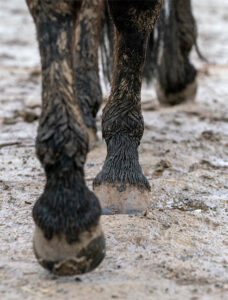
Have you ever entered a barn only to be assaulted by the noxious fumes of ammonia? Your eyes water, your nose waters, your throat closes; you might be tempted to sneeze just thinking about it. Imagine then what it must be like for horses confined in an enclosed space with poor ventilation. Where can they go to breathe sweet, fresh air?
Ammonia buildup can affect a horse’s respiratory health and performance. The most severe exposures have potentially fatal consequences. Ammonia buildup is preventable with sound management practices. Stalled horses exhibit more signs of upper and lower respiratory inflammation than pastured horses. A well-ventilated stable flushes stale air out and allows fresh air to enter. Thus, a stable that can “breathe” has less ammonia, odors, and humidity.
Related Articles
- Horses' Physiologic Responses to Exercise
- Does Hyperbaric Oxygen Therapy Cause Lung Inflammation?
- Electrolyte Use in Performance Horses
- Alternative Treatment for "Roaring" in Horses (AAEP 2011)
- Treating Equine Upper Respiratory Tract Ailments (AAEP 2011)
- Equine Head Flexion and Airway Inflammation (AAEP 2011)
- In Depth: Evaluating the Upper Respiratory Tract (AAEP 2011)
- Managing Bacterial Pneumonia in Adult Horses (AAEP 2011)
- Equine Rhinitis in Respiratory Infection Cases (AAEP 2011)
- Preparing Horse Farms for Winter Weather Disasters